Direct Mail Services
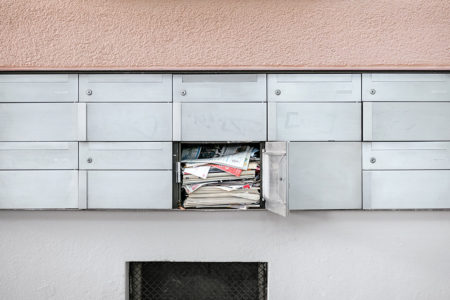
Direct mail marketing is printed outreach — postcards, letters, or self mailers — sent to a targeted list of homes or businesses through the mail. A campaign pairs a clean list with a printed piece, postage, and a drop date.
A typical campaign runs about 56¢ to $1.46 per piece all-in — printing, postage, and list work together; our guide to what direct mail costs breaks the range down. Planned, printed, and mailed from one plant since 1927 — direct mail is one side of our commercial printing services in Chicago.
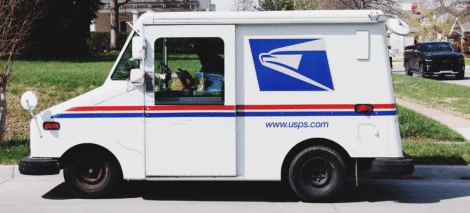
Campaigns at United GMG run for nonprofits, insurance agencies, mortgage lenders, dealerships, and B2B programs across Chicagoland — and USPS delivers them anywhere in the country — from one-time postcard waves to recurring compliance letter programs with certified mail.
- Printing & mailing since
- 1927
- Drops in 2025, one program
- 9
- Certified, every drop
- ~500
- Mail formats, in-house
- 10
Direct mail for campaigns, appeals, and standing programs


Request a quote
Direct mail postcards, letters, and self mailers
Ten formats cover most campaigns — from a first wave of postcards to a certified letter program.
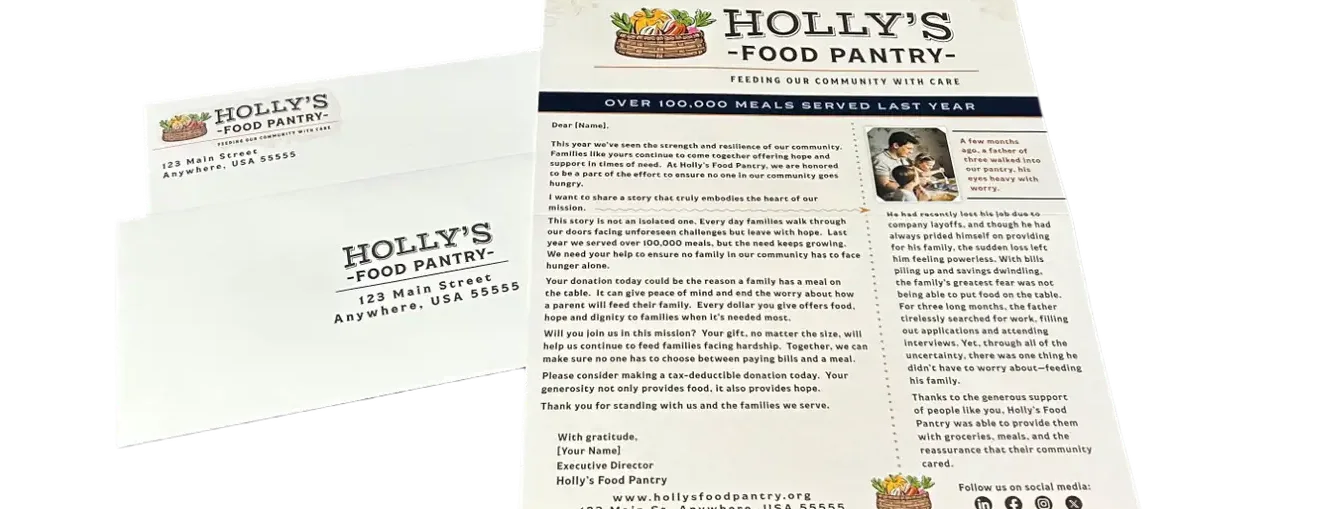


Picked a format? Request a quote →
How much does direct mail cost?
Four things move the price of a mailing: how many pieces you send, the format you choose, the postage class it mails at, and how much list work the file needs. Quantity is the big lever — unit costs step down at volume breaks — and postage is the line most people underestimate.
Ranges by format and quantity: the direct mail pricing guide.
What moves the price
Quantity. Presses and postage both reward volume. Setup is spread across every piece, so a run of 5,000 costs far less per piece than a run of 500 — and presorted mailings earn postage discounts that single pieces never see. If your list is close to a volume break, we will tell you.
Format. A postcard is one printed piece; a letter package is a sheet, an envelope, folding, and inserting; a self mailer folds and seals into its own envelope. Each format carries its own paper, print, and finishing work, and postage treats each differently.
Postage class. First-Class moves faster and costs more; Marketing Mail trades speed for a lower rate. The right class depends on how time-sensitive the piece is — statements and compliance letters usually ride First-Class, promotions usually don't need to. We quote postage at current USPS rates and show it as its own line, never buried in the print price.
List work. A clean file mails cheaper and lands more often: address correction, de-duplication, and move updates all happen before a single sheet prints. If you need a list purchased, that's quoted plainly too.
For your own numbers, ask for a ballpark — we price from your quantity, format, and list, not from a rate card, and the estimate itemizes print, postage, and list work as separate lines.
How does a direct mail campaign run, start to finish?
A campaign moves through nine stages: you approve the list and the piece, we clean the file, print, personalize, and insert, then presort and hand everything to USPS on your drop date. You see a proof before anything runs, and tracking follows each drop to its delivery window.
- St.01List & strategy
- St.02Clean the list — NCOA + de-dupe
- St.03File handoff
- St.04Proof approval
- St.05Print
- St.06Personalize + insert
- St.07Presort & postage
- St.08USPS drop
- St.09Delivery window
Have printed pieces, or a file that's ready to go? Our mailing services in Chicago handle the lists, postage, and the drop; for recurring programs, our direct mail fulfillment services keep the file clean between drops.

The run, stage by stage
The list comes first. Whether it's your customer file or a purchased list, targeting decides everything downstream — who receives the piece, what class it mails at, and what it costs. We flag problems here, not after printing: bad addresses, duplicates, records that moved, and names that belong on a suppression list all come out before the job is priced.
Then the piece. You send print-ready files, or we work from what you have. Every job gets a proof before press — on first runs and reorders alike — so the piece in the mailbox is the piece you approved.
Then the plant. Printing, personalizing each piece where the campaign calls for versions, inserting, tabbing, and addressing all happen under one roof, which is why a question about "where is my job" has a one-call answer.
Then the mailstream. We presort to earn the postage discounts, deliver trays to USPS on schedule, and follow each drop toward its delivery window — useful when a call center or a landing page needs to be ready for the week pieces land. Those real-world measurements let you evaluate a wave and improve the next one; many of our programs mail in rounds, and the second round is always smarter than the first.
How effective is direct mail?
The strongest answer we can give is a program we run: compliance letters in drops of up to ~15,000 at a time, nine drops in 2025, with about 500 of every drop sent certified — because each mailing has to be provable. Campaigns that keep working earn another round; this one has, for years.
We know it arrived, because someone signed for it.
The benefits of direct mail
- Targeted — you choose the list
- Tangible — a piece, not an inbox
- Personalized — versions per audience
- Trackable — drop to delivery window
- Repeatable — waves and rounds
- Pairs with digital follow-up
Real campaigns, documented: direct mail case studies.
The program, in practice
The program behind those numbers is a recurring compliance mailing we run for one client — name withheld, like every client on this site. Each drop is a personalized letter package: printed, inserted, addressed, and presorted here, then handed to USPS with about five hundred pieces of every drop sent by certified mail, per the client's own specification, so delivery is documented piece by piece — a signed receipt comes back for each certified article and is filed with the job.
Nine drops went out in 2025, some as large as fifteen thousand letters. That cadence is the honest measure of the channel: a mailing that didn't perform would not get mailed nine times in a year. As one client put it after a first wave — "the response has been great."
Effectiveness in direct mail is earned in the boring places: a clean list, a piece worth holding, postage class matched to the deadline, and a drop date that's actually met. That is what this plant has done since 1927, and it's why programs stay with us for years at a time.
Who uses direct mail?
- Seg.01Nonprofits
Appeals, donor mailings, galas — often four a year.
- Seg.02Insurance agencies
Recurring acquisition letters, mailed monthly.
- Seg.03Mortgage companies
Rate letters where timing decides everything.
- Seg.04Dealerships & auto repair
Reminders by radius — automotive marketing services.
- Seg.05Wholesale & distribution
Catalogs that outlive any email.
- Seg.06B2B programs
Statements, renewals, named-account campaigns.
- Seg.07Political campaigns
Voter-file mail on deadlines — the political direct mail guide.
Sector notes
Anyone whose next customer has a mailbox can use the channel; these seven are the segments we mail for most. Nonprofit development offices run appeals and donor communications with us in scheduled waves — "we will do 4 mailings" is how one opened the conversation, and that annual rhythm is typical. Insurance and mortgage programs look similar from the plant floor: personalized letters, monthly cadence, and a list that must be re-cleaned before every drop because movers are lost sales.
Dealer and service mailings are usually geography-first — a radius around the shop, mailed in waves. Wholesale and business-to-business pieces run heavier: catalogs, booklets, and spec sheets where the piece itself has to survive a desk, plus the quieter recurring work of statements and renewal letters to named accounts. Political mail is its own discipline of hard dates and voter files; the guide linked above covers the calendar, the formats, and the rules in detail.
If your segment isn't listed, the test is simpler than it looks: if you can name who should receive the piece, a list can be built for it — and if one closed customer is worth real money to you, the math usually works.
How do you choose a direct mail company?
Route to: whoever compares printers
When you compare mail services companies in Chicago, ask three things: does one shop print and mail — or will you coordinate vendors? Will they show you the plant? And is the estimate itemized, with print, postage, and list work as separate lines?
The full checklist lives on our direct mail printing and mailing page.
How buyers compare mail companies
Most buyers arrive with an invoice from their previous printer and a wish for fewer surprises. The pattern in their questions: one accountable shop rather than a broker, an itemized estimate with turnaround and any setup fees called out, and proof that the mailing side is real — not print that gets trucked to a mail house they've never met.
The estimate itself tells you most of what you need: a shop that itemizes print, postage, and list work as separate lines is showing you where the money goes; a single blended number is hiding it. Watch for the postage line especially — it should be quoted at current USPS rates and passed through, not marked up out of sight.
Our answer to the comparison is on this page: the plant has printed and mailed under one roof since 1927, every job gets a proof before press, and postage is always its own line. Visit before you commit — buyers who tour the floor tend to stop comparing.
Direct mail resources
Every direct mail guide on this site, in one place.





Direct mail questions, answered
Q.01What are some examples of direct mail?
Postcards, sales letters, self mailers, brochures, catalogs, newsletters, and invitations are the common ones — all ten formats we print and mail are listed above. The right example depends on the job: a postcard for a fast offer, a letter package for anything personal or official, a catalog when the product line needs room.
Q.02Do you handle the list and postage?
Yes — that's the point of one roof. We source or clean the list (move updates, de-duplication, suppressions), run address certification, presort to earn the postage discounts, and deliver to USPS ourselves. Postage appears on your estimate as its own line at current USPS rates, never buried in the print price.
Q.03How long does a mailing take from files to drop date?
It depends on format, quantity, and how clean the file arrives — a postcard wave and a fifteen-thousand-letter personalized program are different jobs. What's constant: you approve a proof before anything prints, we commit to a drop date when we quote, and if anything threatens that date you hear it from us first.
Q.04Can each piece be personalized?
Yes. Variable printing means each piece can carry its own name, letter, offer, or version — one file, thousands of individual pieces. Most campaigns use it somewhere: a personalized salutation on an appeal, a version per neighborhood, or a fully individual compliance letter. If you can put it in a spreadsheet column, we can print it.
Q.05How do we track a mailing once it drops?
Every drop is followed into the mailstream to its delivery window, so you know when pieces are landing — useful when a call center or a landing page needs to be ready. For mailings that must be provable piece by piece, certified mail adds a signed receipt per piece, the way our compliance program runs it.
Request a quote
Tell us the quantity, the format, and where the list stands — we'll come back with a plain, itemized number. Or request a quote directly, call, or come see the plant.
Return to:
United GMG1864 S Elmhurst Rd,
Mount Prospect, IL 60056
847.588.7600
Serving Chicago & Chicagoland · Nationwide delivery · Since 1927 Schedule a Meeting
New campaign — intake · Form DMS-1
The web version of a reply card — no stamp required. Nine drops flown in 2025; yours can be next.
