Your team's card program
Business Card Printing
United GMG prints custom business cards for Chicago-area teams from one plant in Mount Prospect: 16 pt cover stock with AQ coating, one common back across the team, and each name run as its own lot of 250, 500, or 1,000 — with the master kept on file, so reordering is one email.
That file is the whole point. Your card's artwork, stock, finish, and per-name quantities live with us as the master — new hires join the next run, and the next order reads "the same amount as last time."
Card programs here are quoted by the lot, not sold from a cart. For a number, send three things: your artwork or current card, the stock and finish, and the quantity per name.

Masters kept on file for office sets, design-firm orders, and rebrands — set up once, reordered by email.
Business cards for teams that reorder
Request a quote
The setup — five decisions
What size, stock, and finish should your business cards be?
A team's card is five decisions — here they are on the master, the record card this shop keeps for your team. These values are the ones customers ask for by name; your file carries your own.
- Size3.5 × 2 inches — the standard card. Custom sizes and die-cut shapes run too — the shape is recorded on the master.3.5 × 2 IN
- Stock16 pt cover — the thickness teams spec by name. "We have decided on 16 pt" is how the order usually reads; "a thicker card" is a one-line change.16 PT COVER
- FinishAQ coating — gloss protection over the ink. Matte or uncoated run too; foil (gold included) and painted edges are extras on the same master.AQ
- BackOne common back for the whole team. Every front carries its own name; the shared back prints for everyone — "common back" is the customers' term.COMMON
- QuantityBy the lot, per name. 250, 500, or 1,000 cards per person, set name by name.BY LOT
Point sizes are thousandths of an inch: "16 pt" is a 0.016-inch cover — the difference you feel when a card gets handed over.
Trying to get costs down? Painted edges are the first extra to drop — a one-line change on the quote, not a redesign.
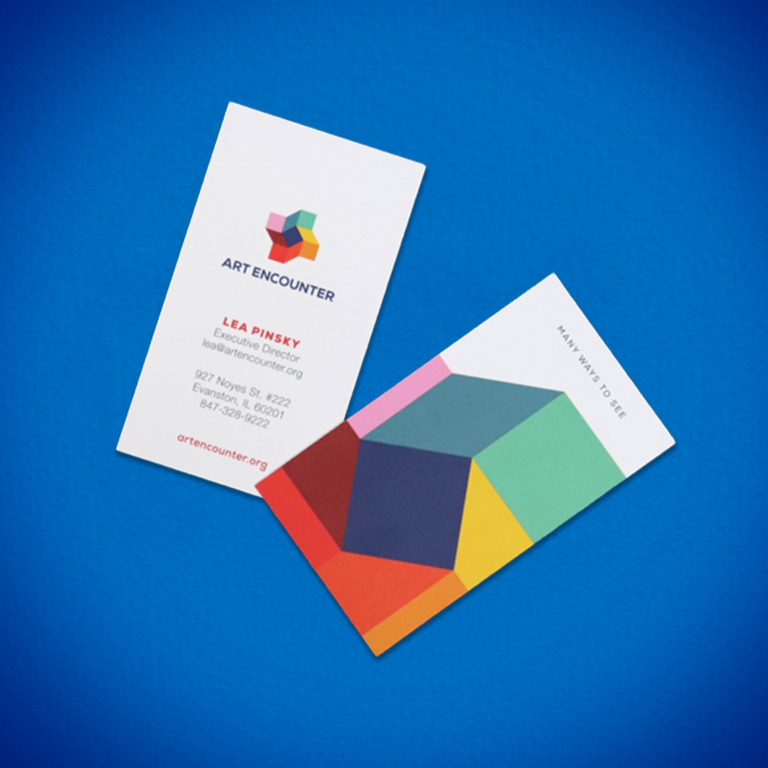
Choosing between the finishes
AQ — aqueous coating — is the default for a reason: a thin gloss layer that protects the ink through pockets, wallets, and card cases, which is where business cards actually live. Matte reads quieter and takes a handwritten note better; uncoated goes further in that direction and suits letterpress-style designs. Foil stamping — gold foil is the classic ask — puts a metallic hit on a logo or a name; embossing and debossing raise or sink it instead, so the card reads by touch. Painted edges color the card's cut edge — the one finish people notice from the side — and it's the first extra to cut when a budget tightens. Die cutting handles rounded corners, notches, and full custom outlines. Every one of these choices is recorded on the master, so the tenth reorder matches the first run exactly — which is the quiet reason teams standardize on 16 pt with AQ and spend their finish budget on the one flourish that fits the brand.
Team sets
Can you print one card design for a whole team?
Yes — that's what a team set is. It runs as one job: the common back prints for everyone, each front carries its own name and title — a QR code too, if your cards use one — and every person gets their own lot.
The largest sets run past a hundred names — "approximately 120 employees with the quantities requested for each" is how one order arrived — and quantities are set per person, not company-wide.
One common back — every name its own front, quantities per person.
How a 120-person card set comes together
The set starts as a spreadsheet: name, title, direct line, email, and a quantity for each person. We flow every front from the master layout, so the hundredth card is set exactly like the first, and you approve a proof before anything runs. The whole set prints as one job — one stock, one finish, one schedule — with the common back running for everyone and the fronts changing name by name. Because every name is its own lot, the finished set arrives already divided person by person, ready to hand out. When people join later, their names are added to the file and run with the next lot; when a title changes, one line changes on one front. Nobody redesigns anything, and the new cards match the old ones because the master never left. That per-person quantity column matters more than it looks: the person who mostly works the phones carries 250 while the one working trade-show aisles carries 1,000, and the order stops paying for cards nobody hands out.
Reorders
How do business card reorders work?
Reordering here is one email, because the file already holds everything else. Three pulls from it — clients named by type, in their own words:
"Business Cards — 4 lots of 250, 3 lots of 500, 1 lot of 1,000."
On later sets: "the same amount as last time" · "these are all on masters."
"We have decided on 16 pt with AQ." One common back; each employee's quantity set individually.
"Common back please" — their standing spec.
"Hopefully you still have the set up — all the information on the card is the same."
That's the ask the file exists to answer.
The standing commitment: masters stay on file with us — artwork, stock, finish, shape, and each person's quantity — so a reorder is a one-line email, and "the same amount as last time" is a complete purchase order.
What the file actually keeps
The master is your card design, kept ready to print: the approved artwork for the common back and every person's front, the stock and finish choices, the shape if the card is die-cut, and the lot quantity each name reorders at. A reorder only has to say what changed — usually nothing, sometimes a title fix or a few new names — and the run matches the last one because it comes from the same record, not from a re-supplied file that might be one revision stale. That's also what makes a rebrand orderly: the new artwork replaces the old on the master, and everything printed from that day forward carries it, while the names, quantities, and stock choices ride through untouched. The file outlives the person who set it up — which, for the admin who inherits a card program mid-year, is the point.
Cost
How much do 500 business cards cost?
At United GMG, a lot of 500 business cards is quoted from two choices: the stock (16 pt cover is the team standard) and the finish — AQ, matte, foil, or painted edges. One- or two-sided costs the same. Each job carries one setup, spread across every card in the run, and the estimate comes back itemized by lot.
Card stores sell from a cart, one price for everyone; a program printer like United GMG quotes the job, because team sets differ — lots per name, common backs, finish choices. The table shows the program's as-low-as pricing. Send your choices with a quantity per name and the numbers come back on one estimate.
Baseline shown: 16 pt cover with AQ coating and one common back. Thicker stock, foil, painted edges, and die-cut shapes move the number.
| Order sizeone lot = 500 cards, one name | As low asone- or two-sided alike |
|---|---|
| 1 lot of 500 | $69 |
| 5 lots of 500 | $49/lot |
| 10 lots of 500 | $39/lot |
As-low-as covers the baseline spec, and a common back costs no more than a blank one — your exact set comes back itemized. One estimate, itemized by lot.
Does the price only drop at the 500-quantity level?
A customer asked exactly that — "does it only drop at the 500 qty level?" The tiers above answer it: the per-lot price steps down at 5 lots and again at 10, and the estimate still prices each lot on its own line. Why cards are counted in lots at all:
1 · Cards print together on one big press sheet — the count varies by size and stock.
2 · One cutting pass turns the sheet into cards.
3 · Cards come off the cutter counted into lots — 250, 500, or 1,000 per name.
What moves a card quote, in plain words
Four things set the number — the same choices the master records. The stock: 16 pt cover is the team standard; heavier and lighter covers run too, and the choice is priced into the lot. The sides are not one of the four: a two-sided run with a common back prices the same as a one-sided run, which is why the table shows a single as-low-as figure. The finish: AQ is the baseline; foil, embossing, debossing, and painted edges each add a real production step, which is why "without painted edges" is the classic cost-down request. The shape: a die-cut card adds cutting work that a standard rectangle doesn't need. And the lot sizes: a run's one-time work — getting the master onto the press and the first sheets right — is shared by every card in that run, which is why the per-lot price falls as lots are added: the step the as-low-as tiers above show. That's the entire model. Send the five choices and the estimate prices your set, lot by lot.
Who it's for
Built for teams that reorder
This page is for the person who owns everyone's cards: the office admin or marketing coordinator running the team's set, and the design firms ordering for their clients — often cards and matching envelopes in the same pass.
Our boundary, stated plainly: we're a commercial printing company that sets up and keeps card programs — masters on file, per-name lots, common backs. If you need a small one-off batch for one person, an online card store will genuinely serve you better. If you're setting up cards for a team that will reorder them, that's exactly what the file is for.
The plant
Business card printing — from one Mount Prospect plant
Cards print at our own plant in Mount Prospect, northwest of Chicago — the same building that runs our presses, bindery, and finishing, and the same floor you're welcome to visit and watch a run on.
Cards are one lane of the shop. The whole floor — offset and digital presses, bindery, mailing — is on our Chicago commercial printing page. Finished cards ship nationwide — the master stays filed here.
1864 S Elmhurst Rd
Mount Prospect, IL 60056
847.588.7600
Related products
New logo? The file gets updated — not started over.
Rebrands arrive as one email: "we have changed our logo and brand standards" — cards and matching envelopes, please. The master takes the new artwork; everything that pairs with it updates in the same pass.


Short answers
Common questions from the card file
What is a "master"? And a "common back"?
The master is your card design, kept on file and ready to print — artwork, stock, finish, shape, and each person's quantity. The common back is one shared back design the whole team prints with, while every front carries its own name. Both terms come from how customers actually write their orders.
What's the standard business card size?
3.5 × 2 inches — the size that fits card cases, wallets, and rolodexes, which is why it's the default almost everywhere in the United States. Custom sizes run too, and the size is recorded on your master so every later order matches the first. If you're pairing new cards with existing holders or presentation folders, standard is the safe call.
Can you print die-cut or custom-shaped cards?
Yes — die cutting runs in-house: rounded corners, notches, or a fully custom outline. The shape is recorded with your master, so reorders match the first run exactly. One practical note from the floor: a shaped card still works best when it stays close to wallet size, because a card that doesn't fit where cards live tends not to travel.
One-sided or two-sided?
Both run. Two-sided is where the common back lives — the shared design that makes a whole team's cards read as one set — and where a map, a QR code, or a second language fits without crowding the front. One-sided is the budget pick when the front says everything.
Can each person on the team order a different quantity?
Yes — that's the normal shape of a team order. Quantities are set per name — lots of 250 for one person, 1,000 for another — on the same run, at the same stock and finish. One order we set up covered approximately 120 employees, each with their own quantity — and each later reorder adjusted only the names and counts that changed.
What should a business card include?
Name, title, direct line, email, and the website — plus a QR code if your team uses one for contact-saving or scheduling. The common back usually carries the brand; the front carries the person. Less is more: a card that breathes reads better than one that's full.
How much do custom business cards cost?
Business card printing is quoted by the lot, from three choices: stock, one- or two-sided printing, and finish. Each lot size is priced on its own line of the estimate — 250, 500, and 1,000 side by side — so the comparison is real numbers, not a rule of thumb. The cost section above shows how the lot sheet is laid out; send your three choices for the figures.
How fast do reorders arrive?
Timing depends on the lot sizes and the finish, so the real answer comes back with your estimate rather than as a blanket number on a page. Tell us when you need cards in hand, and the quote speaks to that date.
Set it up once — every card after is one email.
- Size — 3.5 × 2 inches, or your shape
- Stock — 16 pt cover, the team standard
- Finish — AQ, matte, foil, painted edges
- Back — one common back for the team
- Quantity — by the lot, per name
Filed. Kept. Reordered by email.
Open a file — request a quote
Send the artwork or your current card, the stock and finish, and the quantity per name. The estimate comes back itemized by lot.
